

Redirect URL integration
Set up a Redirect URL integration so 24metrics can screen clicks before they reach your offer. Use this with platforms such as Everflow, HasOffers, Trackier, Affise, Cake, or Swaarm, or with a custom tracking setup.
How it works
Section titled “How it works”A Redirect URL integration puts 24metrics between your tracking link and the offer:
- An affiliate clicks your tracking link.
- The tracking link points to a 24metrics protected link.
- 24metrics screens the click for fraud.
- If the click is clean, 24metrics redirects to the original offer URL.
- If the click is rejected, 24metrics blocks it or sends it to a fallback URL.
What you will do
Section titled “What you will do”| Step | Action |
|---|---|
| Create the integration | Go to Integrations → Create → choose Redirect URL → Next |
| Choose a template | Set Tracking Platform Links Template to your platform, or Custom |
| Map macros | Required only when the template is Custom |
| Create a link | Paste the offer landing page URL into 24metrics and save |
| Update your platform | Replace the offer URL with the protected link from 24metrics |
| Enable filters | Open the Global Filters tab and turn on the checks you need |
| Choose fraud action | Block rejected clicks, or send them to a fallback URL |
Integration setup
Section titled “Integration setup”Create a redirect URL integration
Section titled “Create a redirect URL integration”- Open Integrations in the main menu.
- Click Create.
- Enter an Integration Name (for example,
EverfloworDemo Lead Gen). - Under Select Integration Type, choose Redirect URL.
- Click Next.
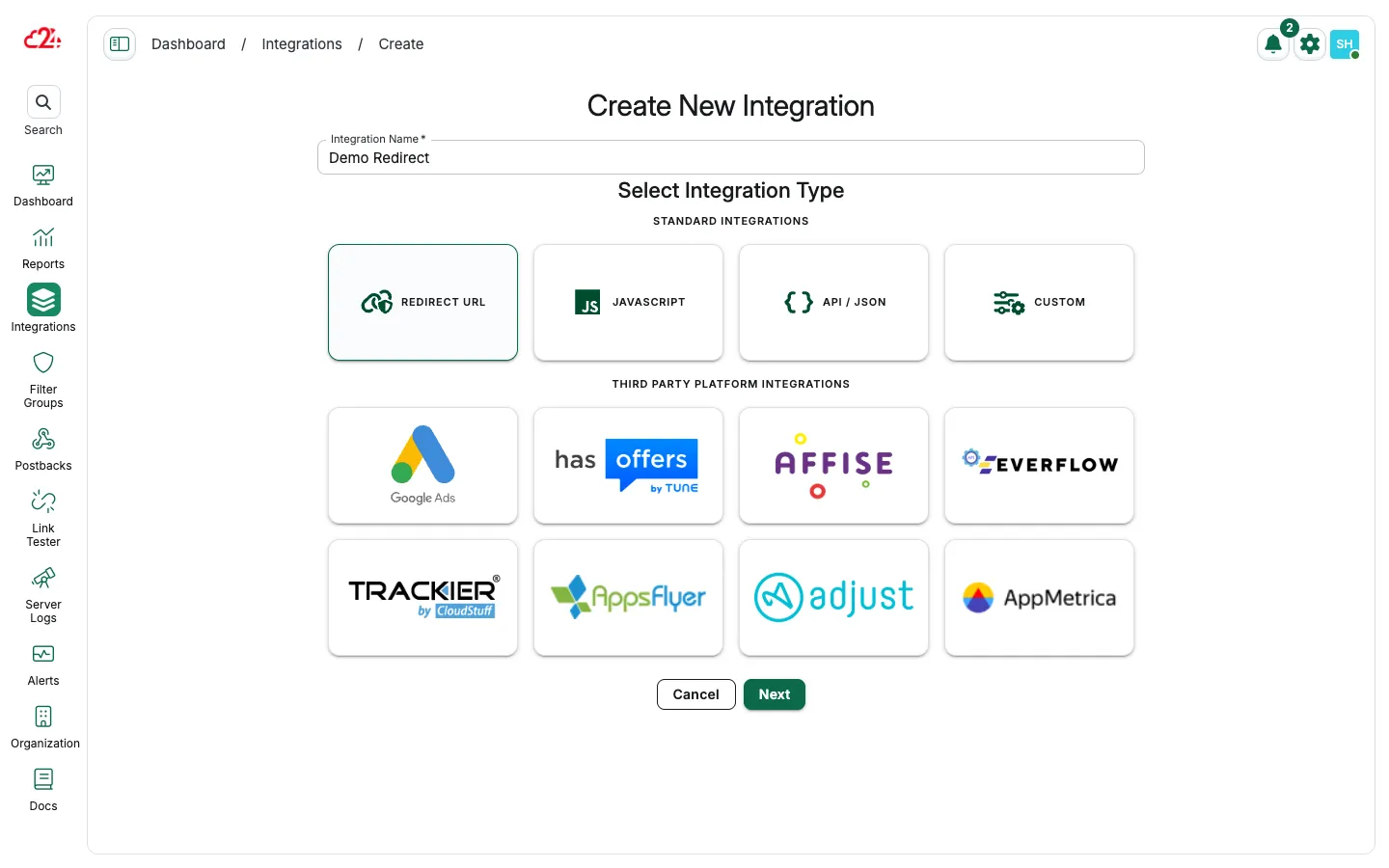
Choose a tracking platform template
Section titled “Choose a tracking platform template”On the next screen, set Tracking Platform Links Template:
- Choose your platform when it is listed: Everflow, HasOffers, Affise, Trackier, Cake, or Swaarm.
- Choose Custom if your platform is not listed or you use a proprietary tracker.
You can change the template later. If the integration already has many links, create a new integration instead of changing the template on the existing one.
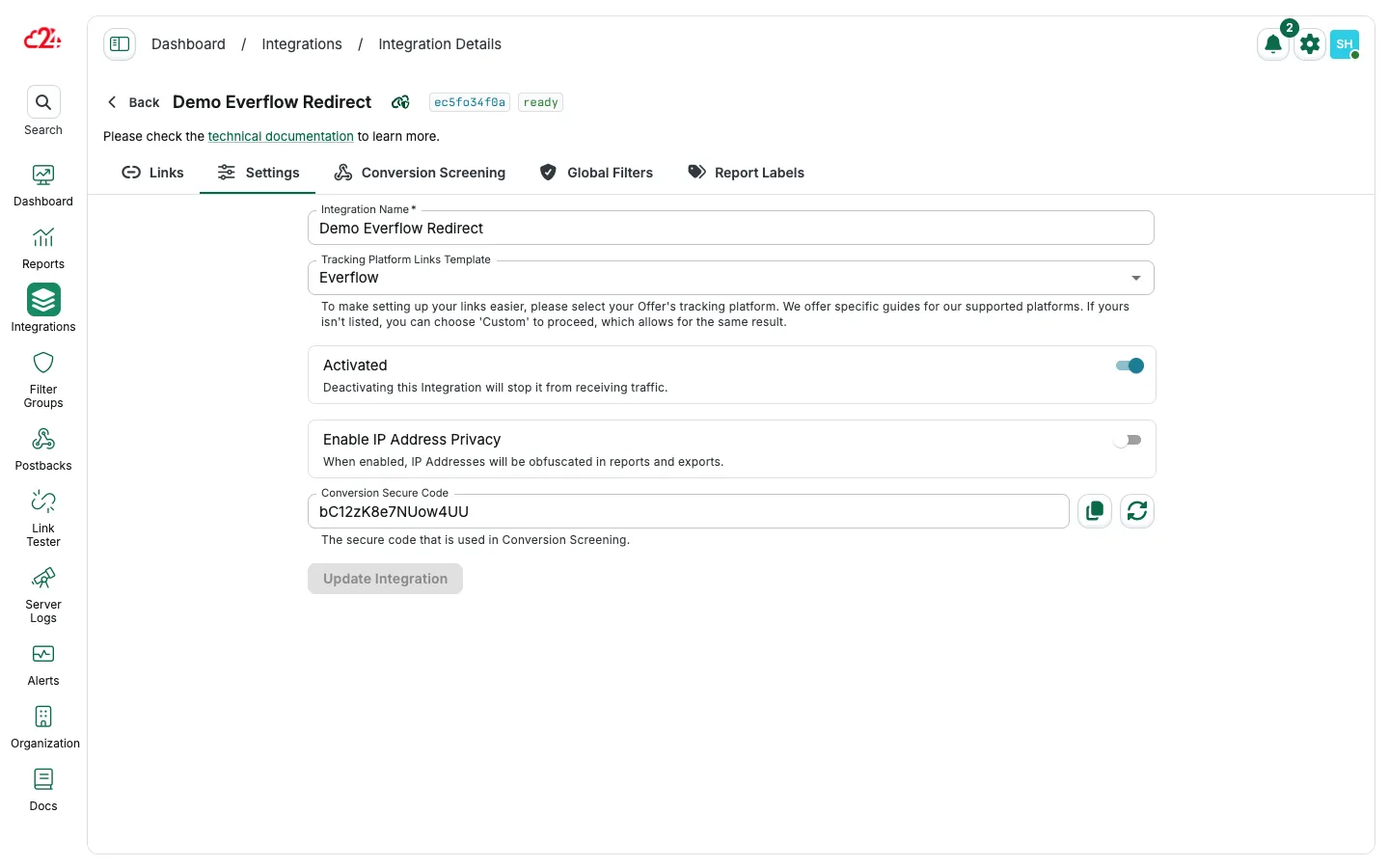
Custom parameter mapping
Section titled “Custom parameter mapping”If you chose Custom, map the macros your platform uses so 24metrics can pass the right values through the protected link.
Example mapping:
- Publisher Macro →
{affid} - External Transaction ID →
{clickid} - Sub ID Macro →
{sub1} - Device ID →
{device_id}
Use the exact tokens your platform expects.
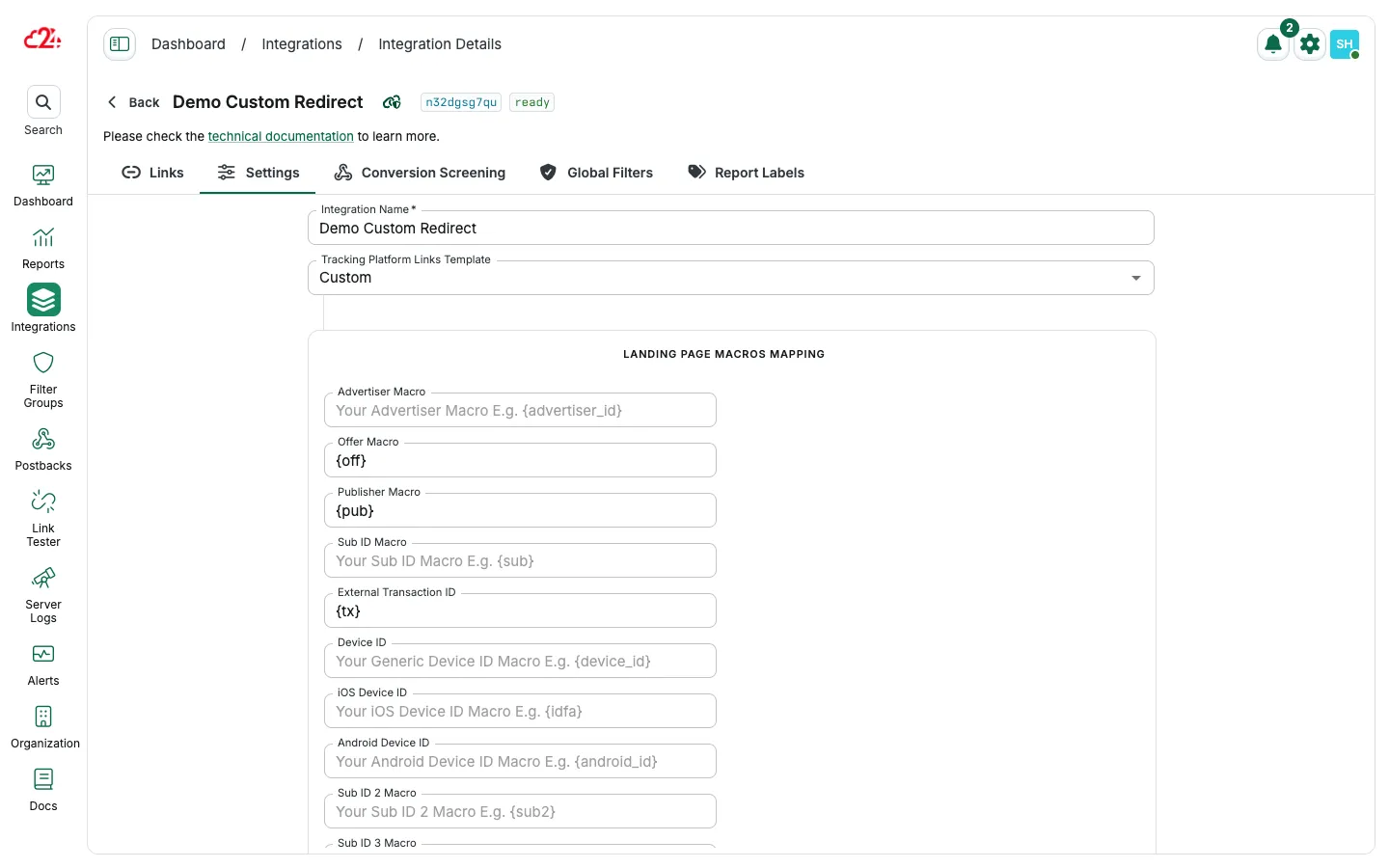
When the mapping looks correct, click Save.
Platform templates
Section titled “Platform templates”If you chose a supported platform template, parameter mapping is preconfigured. You do not need to map macros yourself.
Platform-specific setup notes:
Wait for the integration to be ready
Section titled “Wait for the integration to be ready”After you save, wait up to 20 minutes before you use the integration. Check the readiness status on the integration page. When it shows ready, continue with the link steps below.
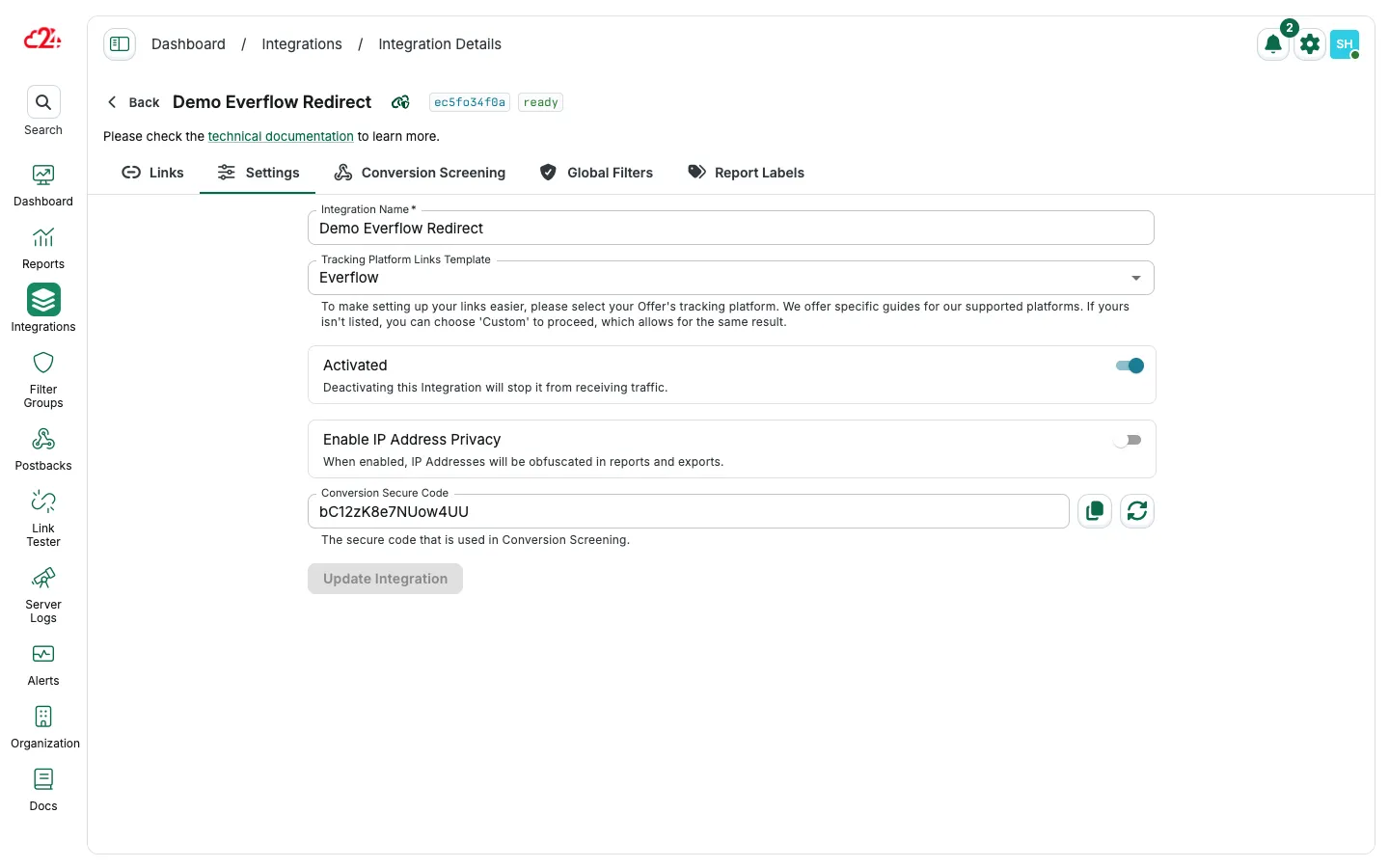
Create a protected link for your offer
Section titled “Create a protected link for your offer”Overview
Section titled “Overview”Create one Link for each offer or landing page you want to protect. Saving the link generates a protected URL that you paste back into your tracking platform.
Prerequisite
Section titled “Prerequisite”In your tracking platform, open the offer URL configuration and copy the destination URL, including any parameter macros.
Create the link
Section titled “Create the link”-
Open the integration and go to the Links tab.
-
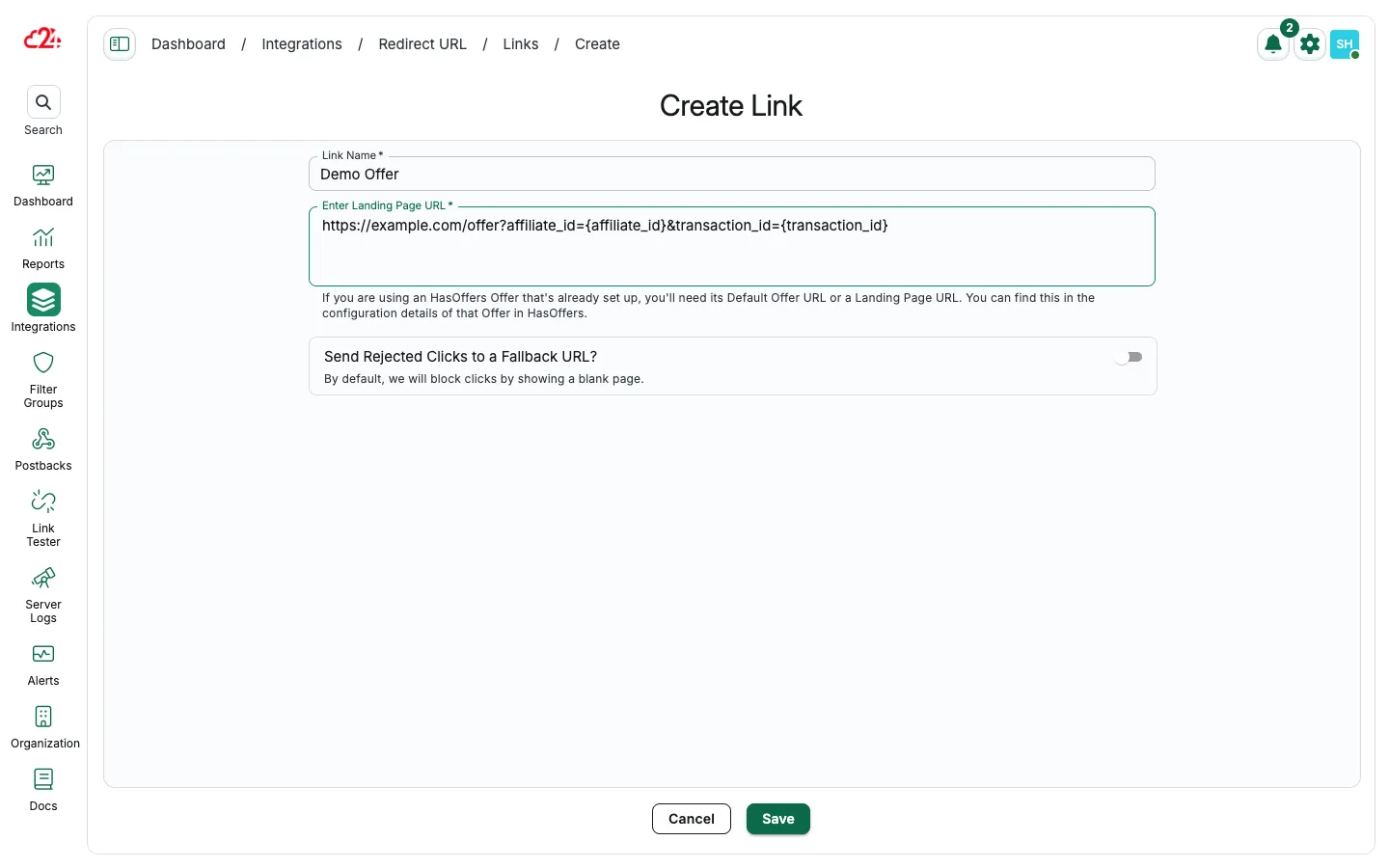
Click Create.
-
Enter a Link Name. Use the same name as the offer when you can.
-
Paste the destination URL into Enter Landing Page URL, exactly as it appears in your platform.
-
Optional: turn on Send Rejected Clicks to a Fallback URL? and enter a fallback URL. By default, rejected clicks see a blank page.
-
Click Save.
-
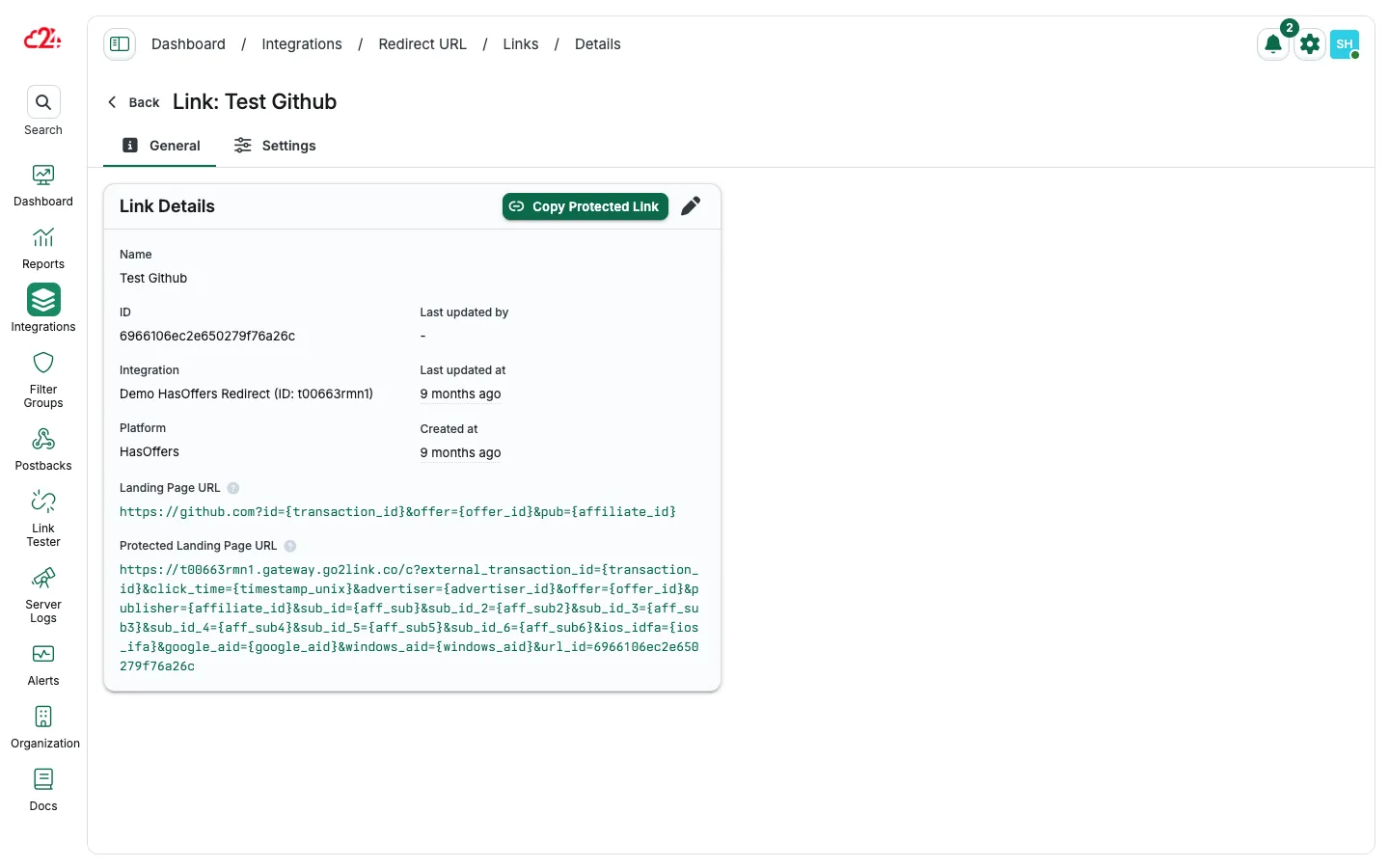
Copy the generated protected link.
-
In your tracking platform, replace the original offer URL with the protected link.
Testing the integration
Section titled “Testing the integration”- From your platform, generate a normal click tracking link for the offer.
- Open that tracking link in a browser.
- If you see a blank page, or you land on the fallback URL, the click was rejected and screening is working.
- Open Reports → click reports and confirm a new click appears after a few seconds.
Known issues
Section titled “Known issues”- Connection is not secured.
- This site can’t be reached.
If you see either message while testing, wait the full 20 minutes after creating the integration. If it still fails, contact support.
Configuring fraud protection
Section titled “Configuring fraud protection”Open the integration Global Filters tab. Choose Clicks, Conversions, or Impressions, then enable the checks that apply to this traffic. Common click checks include Emulator & Bots, VPN / Proxy, Click Flooding, GEO Filter, Device Anomaly, and Compliance Checks.
Global filters are the fallback when no custom group matches. Use Filter Groups for source-specific rules and separate click and conversion preset browsing.
Example: enable bot protection
Section titled “Example: enable bot protection”- Open the Global Filters tab.
- Select Clicks.
- Open Emulator & Bots and enable Enable Emulator & Bots Filter.
- Configure the visible options, select Done, then use the page-level Save changes action.
Blocking vs monitoring mode
Section titled “Blocking vs monitoring mode”Under Click Fraud Screening Options (Prevention / Detection), choose the blocking or monitoring mode and select Save changes. Preset browsing and filter drawers use the same editor as Filter Groups.
Monitoring mode
Section titled “Monitoring mode”Rejected clicks still appear in reports, but they are not blocked or redirected. Use this when you want to measure fraud before you enforce blocks.
Blocking mode (default)
Section titled “Blocking mode (default)”Rejected clicks are blocked or sent to the fallback URL you configured on the link.
Common mistakes to avoid
Section titled “Common mistakes to avoid”- Do not manually change parameter tokens in the offer URL after mapping is set.
- Do not skip macro mapping when the template is Custom.
- Do not leave filters disabled if you expect fraud screening to protect the offer.
Next steps
Section titled “Next steps”- Platform redirect URLs for Everflow, HasOffers, Affise, Trackier, Cake, and Swaarm notes
- Click reports to verify screened traffic
- Affiliate postback setup when you need conversion callbacks